
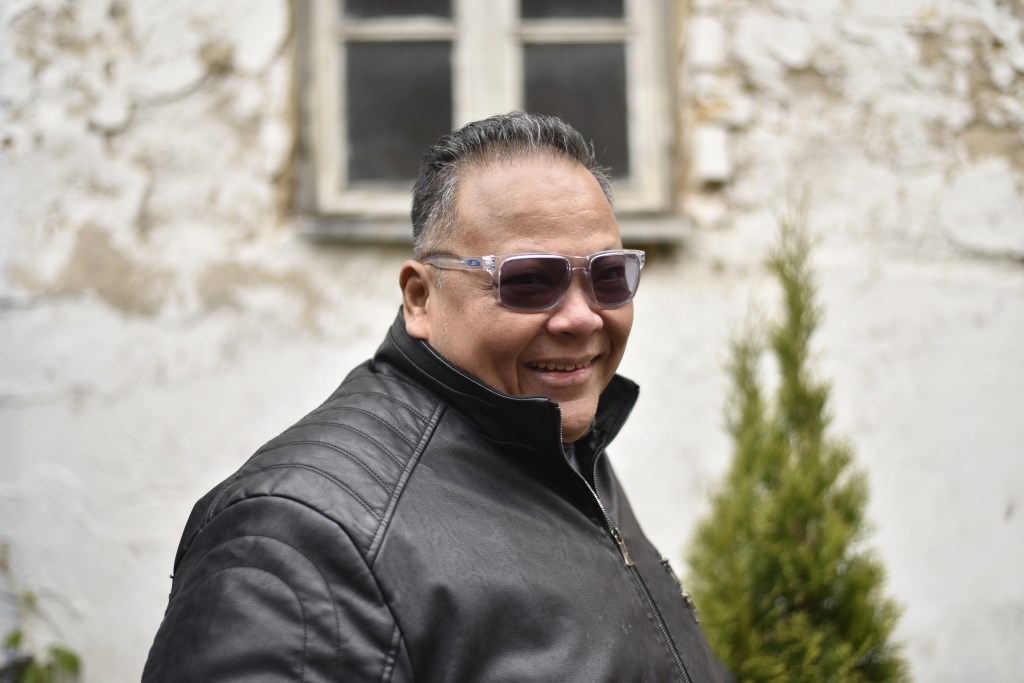
Sherman Lucharl Tan Hoon Heng, better known as Sherman Tan carries a rich cultural heritage. Born in Malaysia to a Chinese father and a mother of Welsh-Indonesian descent, his identity has always straddled different worlds. Despite his Chinese roots, Sherman doesn’t fit the stereotypical image, a fact that has followed him throughout his life and career. He has been in the music industry for more than 3 decades and is best known to the Lithuanian audience as a participant of “The Voice of Lithuania” contest.
We meet in his bar (Lucille Blue’s bar) on a chilly Monday afternoon. We talk, take pictures and he tells me a story about his favourite guitar. Read our interview below.
Can you start by telling me a bit about yourself—your background, your roots?
My full name is Sherman Lucharl Tan Hoon Heng. I’m Malaysian Chinese. My father is Chinese, and my mother is half Welsh, half Indonesian. My grandfather was a white man—his name was John William Lloyd. So I’m Chinese, but I don’t really look like it.
How did you end up in Lithuania?
I married a Lithuanian woman. I met her in Malaysia. At the time, I was taking care of my son alone—my ex-wife had left. My son was very sick from a young age. He had a mitochondrial disease, which affected his muscles and growth hormone. He had to be tube-fed. I took care of him for about four years until he passed away at just eight years old. Around that time, I met this Lithuanian lady, and when my son passed, she flew all the way to Malaysia to be with me. I needed a new beginning, so I moved to Lithuania. We got married, and then COVID hit—I couldn’t return to Malaysia. We bought a country home in Rokiškis and settled down.
Were you able to continue doing music after moving?
I tried. I was singing, but it was tough. I didn’t speak the language, and finding a music scene was difficult. But people eventually got to know me. I started jamming, played some festivals, like the Wild Blues festival. In 2019, I took part in a talent competition here—made it almost to the finals, but didn’t win. Still, it was a good experience.
How was life in Rokiškis?
It was peaceful. We were happy, in a sense. But I’m an extrovert—I need people around me. Music is about connecting with people, performing, sharing energy. My wife was there for me while I was grieving, but after some time, I needed more. Eventually, we drifted apart. It was mutual, but it wasn’t easy. I went back to Malaysia for a while but then realized that I actually love Lithuania. I had built something here. Why should a failed relationship push me away from a place I had started to call home?
Music is about connecting with people, performing, sharing energy.
Is that when you started thinking about opening a bar?
Yes. I had been playing in this bar called “Happy Brew”. They had a dart area and a beer bar. I asked if I could use the dart space to play music on weekends. My saxophonist friend joined me—we’d perform for tips during the COVID period. This was around 2021–2022.
And you made a small venue out of it?
Exactly. I decorated it with candlelight, small tables. People started coming, we played shows… After that, I went back to Malaysia again—I’d won a Hard Rock competition, and they flew me to Osaka, Bangkok… I was even scheduled to perform at the Hard Rock Hotel in the Maldives for 26 days. It was meant to be a trip with my wife, but we had separated, so I went alone. Beautiful place, but the timing wasn’t right.
I came back to Lithuania again and told myself—I’m going to open a real bar.

And that became Lucille?
Yes. I bought the bar from the previous owner.
What kind of place is Lucille today?
We have live music five days a week. The bar’s small— host max 40 people. On weekends, people often walk in and leave because there’s no space. But we’ve hosted artists from across Europe and even further away. It’s hard financially because we only sell drinks. But the atmosphere? It’s something special. Just yesterday, a British choir came from Trakai—25 people—and they loved it.

I visit other bars, but none of them give me the same warm feeling. I understand Lithuanians can be reserved, but those who’ve traveled and come back—they get it. I’m proud of what I’ve built. Someday I’d love to open a bigger bar—or maybe even a Malaysian restaurant!
What was your life like in Malaysia? What music shaped you?
I was a naughty kid! But I always loved music. I never thought I’d be a performer or a guitarist. I studied hotel catering management and during my internship at a resort, I used to play guitar and sing. One of the managers heard me and suggested I perform during happy hour. I had a flowery shirt, white pants—very Hawaiian! I biked to the bar with my guitar, and people loved it. Tips were great. From there, other resorts started hiring me. Eventually, I stopped training and chose music full-time.
What genres did you play?
Everything—rock, soul, blues, country and western. In Malaysia, we’re very diverse. We play American and British music too. I had a country band! But I’ve always been drawn to soul and blues.
Why blues, why is it so special to you?
Blues is about the heart—it’s raw emotion. Unlike jazz, which is often structured, blues gives you freedom. It’s the root of many genres.
Blues is about the heart—it’s raw emotion. Unlike jazz, which is often structured, blues gives you freedom. It’s the root of many genres. Every musician should know the blues. It’s universal. That’s why I named the bar Lucille—after B.B. King’s guitar. Blues, soul, funk—it’s all connected.

Who were your biggest influences?
Of course, the legends like B.B. King and Eric Clapton. But also Paul Ponnudorai—he was Malaysian, and he was incredible. Played bass and rhythm at the same time, just like I do. He had a perfect pitch, was humble, and deeply respected. He passed away in his late 40s, but he left a huge legacy. You should look him up—he even replaced Dominic Miller once at a guitar festival.
Do you find other people in Lithuania with your playing style?
Not really. It’s a niche style. Some can do it, but I haven’t met many here. That’s why I say—Lithuania needs an avenue. There are talented people, especially the youth, but they don’t always have the support. There’s this young girl who plays here—she’s been through depression and gets criticized for her appearance. But here, she’s free. She goes on stage and just lets it all out. That’s what Lucille is for.
I agree—some young people are struggling emotionally more than before.
Yeah. Today, we have all the knowledge at our fingertips, but we’re missing the emotional connection. Music is a way to bridge that. When you sing something and someone connects with it—that’s powerful. That’s why I say, I’m not the best musician, but I sing from the heart.

Do you write your own music?
I do, but I procrastinate a lot. I’m always criticizing myself. One song I wrote quickly—about my son—took just 15 minutes. When I write, the melody and lyrics often come together naturally. I like to write from emotion, from what I’ve been through.
Will you release anything soon?
Yes, I’m planning to release an album by the end of the year. It’ll be a mix of blues, soul, acoustic songs—quiet, heartfelt stuff. Maybe some cello in the background. It’ll be emotional, introspective—music that really feels something.
When you sing something and someone connects with it—that’s powerful. That’s why I say, I’m not the best musician, but I sing from the heart.
Any upcoming performances?
I’ll be playing at the Suwałki Blues Festival in Poland. A couple of Malaysian musicians are joining me. I used to do a lot more festivals, but running the bar has taken up a lot of time. Still, I’m always performing—if not out there, then right here at Lucille’s Blues Bar.
Sherman Tan on Instagram
“Lucile’s Blues Bar” on Instagram
“Lucile’s Blues Bar” on Facebook
 Deviant Generation
Great Sherman. Wishing you the very best and hope to see you soon in Stuttgart
LikeLiked by 1 person